Small-Batch 3D Printing
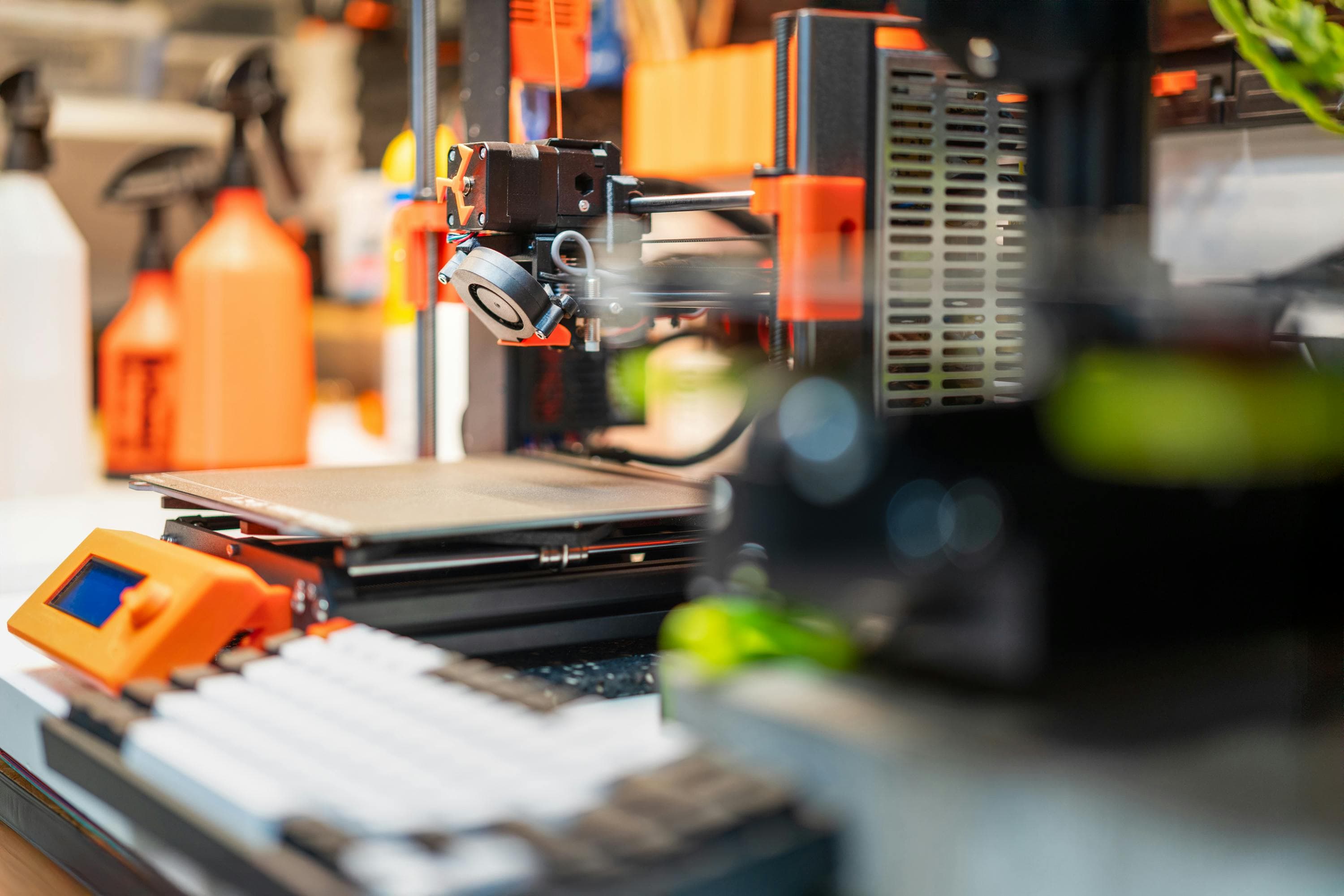
If you need 50, 200, or 1000 of the same part, you're sitting in the awkward gap where injection molding is too expensive and one-off 3D prints are too slow. Small-batch 3D printing is the natural answer to that gap: zero tooling cost, short lead time, freedom to tweak the design between runs.
This article covers when small-batch 3D printing is the right choice, what the workflow looks like end to end, and where the line is at which traditional manufacturing starts to win.
When small-batch 3D printing is the right call
A typical injection mold tool runs €5,000–30,000 and takes weeks to fabricate. If you're producing 100,000 units, that cost spreads thin. If you're producing 200, the tool alone adds €25–150 per unit before any plastic flows.
3D printing inverts the math: every unit costs the same, from the first to the last. Specifically:
- Tooling cost = 0. You only pay for material and machine time.
- First unit ships the same week as the hundredth — no waiting for a tool to be built.
- The design can change between runs. If a customer asks for a tweak after 50 units, you adjust the CAD file and continue — no mold recutting required.
- Inventory burden disappears. Order 100 now, order 100 more later — print on demand.
The simplest test: is your quantity below 1,000 units? If yes, 3D printing is almost always cheaper and faster.
Common use cases
Where small-batch 3D printing is everyday practice:
- Pilot runs. The first 100–500 units of a new product, used to validate market fit before committing to tooling.
- Replacement parts. A run of 50 components for legacy equipment whose original supplier has discontinued service.
- Custom B2B products. Client-specific designs in the 50–500 range — too many to make by hand, too few for mass production.
- Promotional items. Logos, stands, branded objects in runs under 1,000.
- End-of-life support. Products that are out of production but still need spare parts for a few more years.
- Production line aids. Jigs, fixtures, carriers — each one unique, but typical batch sizes of 20–200.
Workflow and lead times
A typical small-batch project with us:
Day 1 — Inquiry and quote. Send your CAD file (STL, STEP) and the required quantity. We return a quote with material recommendation and lead time, usually same-day.
Days 2–3 — Pilot print and review. We print the first 1–3 units to verify tolerances, finish, and that the part meets expectations. This "pre-series" step prevents burning a defect through 100 units.
Days 3–10 — Main batch. Multiple printers run in parallel. As a rough guide: 200 medium-sized units in 5–7 working days, 500 units in 10–14 days.
Final stage — Post-processing and QC. Sanding, painting, assembly, threaded-insert installation. Every unit is inspected before dispatch.
If you have a hard deadline (trade show, product launch), tell us at the inquiry stage — we can stage the batch so part of it ships earlier and the rest follows.
How price scales with batch size
Unlike injection molding, 3D printing has no sharp "break-even" cliff. The cost curves down gradually: bigger batches let us pack the build platform more efficiently and amortize per-batch setup time.
| Batch size | Per-unit price vs. one-off | Note |
|---|---|---|
| 1 unit | 100% | Standard one-off price |
| 10 units | ~85% | Setup amortized |
| 50 units | ~70% | Material discount, fuller build chamber |
| 100–500 units | ~55–65% | Optimal production rhythm |
| 1,000 units | ~50% | Near the maximum discount |
Above 1,000 units, it's worth running an injection-molding cost comparison — that's where mass production starts to win. See 3D printing vs injection molding for the full breakdown.
For a per-unit estimate use the pricing calculator or read the full pricing guide.
Material choice for batch production
A single prototype tolerates experimentation; series production demands a material that's predictable. Some rules:
- PLA — cheap, fast, visually clean. Suits promotional items, demo units, indoor use. Not heat-resistant.
- PETG — tougher, chemical-resistant, fits functional parts. Our default for B2B batches.
- PETG Carbon — rigid and dimensionally stable, suited for mechanical series parts.
- ABS — closest to injection-molded properties, but slower and needs post-treatment.
For a deeper material walk-through see 3D printing materials in Estonia.
Quality control across the batch
A common worry: is unit #200 identical to unit #1? The answer is yes, provided the printer is calibrated and a reference print is made at the start of each batch.
Our process:
- Reference part is printed at batch start and measured with a digital caliper.
- Spot inspection every 50 units — random sample, dimensional check, visual review.
- Final inspection on every unit before packaging.
- Measurement protocol kept on file for the whole batch and shared with the client on request.
If your part needs tighter tolerance (±0.05 mm), FDM is the wrong technology — for those cases we offer a hybrid where 3D printing produces the geometry and CNC post-machining hits the precision spec.
When to graduate to injection molding
Above ~1,000 units, ask for a parallel quote — ours via 3D printing and one for injection molding. Molding starts to win when:
- Annual quantity exceeds 2,000–5,000 units.
- The part is geometrically simple, with even wall thickness.
- Material is a common high-volume commodity (ABS, PP, PE).
- The deadline is flexible enough to absorb 4–6 weeks of tooling time.
Molding loses its edge when the part has complex internal geometry, hollow chambers, or when you want to tweak the design between runs. Full comparison: 3D printing vs injection molding.
Frequently asked questions
How big a batch fits at once?
A single 800 × 800 × 1000 mm build chamber holds 20–50 medium-sized parts. For higher volume we run multiple printers in parallel. A practical weekly maximum is 500–1,000 units, depending on part size.
What if some units come out defective?
Every unit is inspected before dispatch. If any fails tolerance (e.g. layer-line warping), we reprint the replacement at no extra cost. Our typical defect rate on series work is under 2%.
Can you keep the CAD file for repeat orders?
Yes. After your first order we keep the file in secure storage. For repeat orders, just write "another 100 of the same design" — the setup step is skipped.
Can you produce 5,000 units?
Yes, but at that volume we always run a parallel injection-molding quote and recommend whichever is more economical for you.
Do I need to sign a framework agreement?
Not for a single batch. If you plan recurring orders (monthly, quarterly), a framework agreement gives priority queue placement, volume discounts, and locked-in pricing for the contract period.
Summary
Small-batch 3D printing wins when:
- Quantity is 50–1,000 units and injection-molding economics don't pay off yet.
- The design may still evolve — between-batch tweaks don't require a new tool.
- The deadline is short — first units in days, not weeks.
- The part is complex — internal cavities, organic shapes, multiple materials in one piece.
Start your batch project with a quote request or check rough pricing in the calculator.