Multicolor and Multi-Material 3D Printing
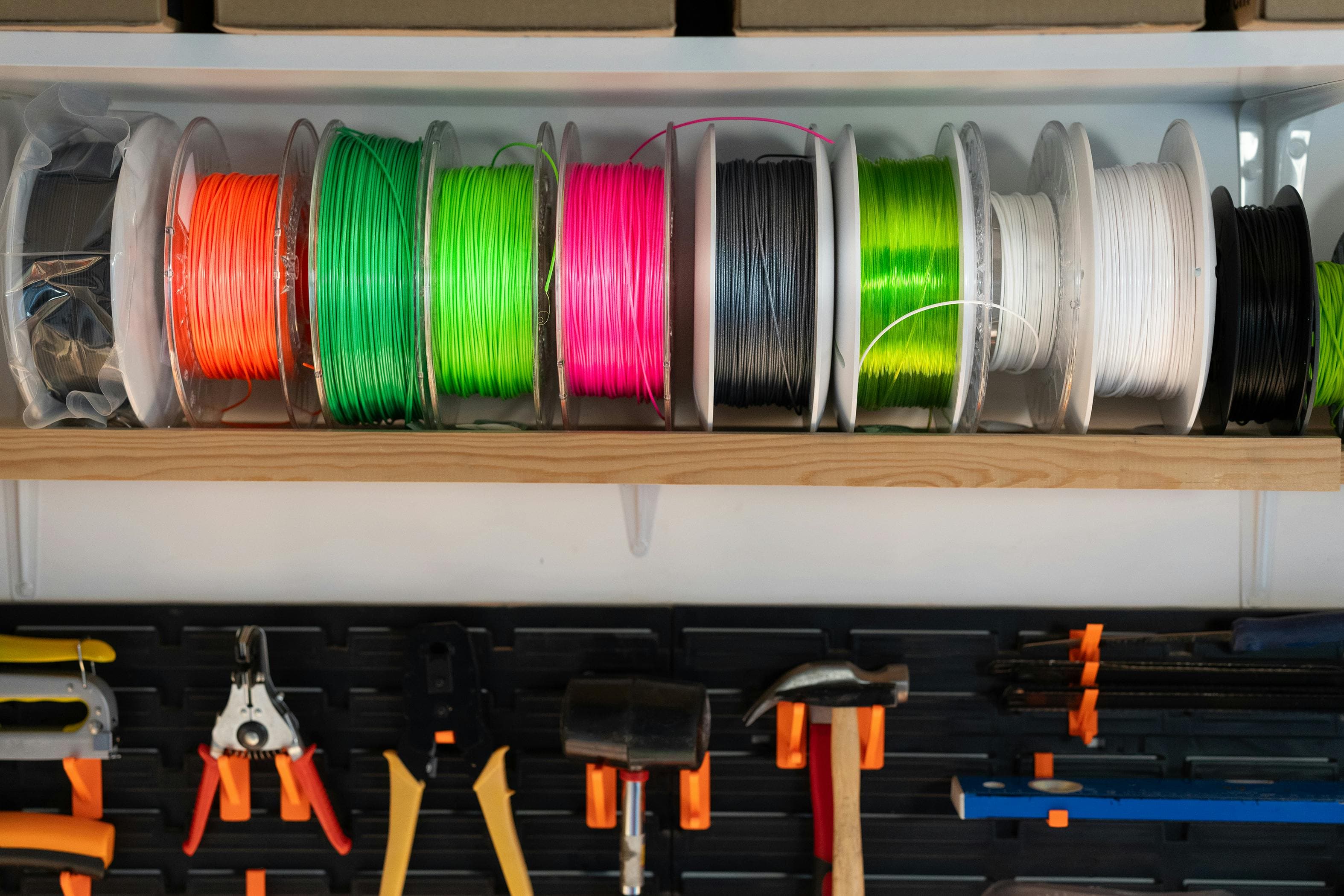
Single-color 3D printing is straightforward. Multicolor and especially multi-material 3D printing open a new category — where one part can carry two colors, transparent and opaque sections, or a rigid and flexible material at the same time.
This article covers the available color approaches, when they make economic sense, and when it's better to print in one color and paint afterwards.
Approaches to multicolor 3D printing
A multicolor result can be produced several ways. Each has trade-offs:
| Approach | Color count | Best for | Trade-off |
|---|---|---|---|
| Multi-filament FDM (AMS-style) | 2–16 | Logos, two-tone enclosures, sharp color boundaries | All colors stay distinct — no smooth gradients |
| Full-color resin (CMYK-style) | Unlimited | Busts from photos, miniatures, prototypes with gradients | Less durable than FDM, more expensive |
| Sandstone full-color | Photorealistic, unlimited | Sellable models, souvenirs, architectural visualizations | Brittle, doesn't take usage load |
| One material + paint after | Unlimited | When the part needs gradients or metallics | Adds labor, but most permanent finish |
In practice: for most B2B orders, AMS-style multi-filament FDM is the most common pick. It produces clean color zones without needing a paint pass.
Multi-material printing: when materials must differ
Distinct from multicolor, multi-material is more complex and significantly more useful for functional orders. Typical cases:
- Rigid frame + flexible gasket. The body in PETG, the inner sealing ring in TPU (rubber-like). One part, two materials, integrated without assembly.
- Soluble support structures. The main part in PLA, internal supports in PVA — water-soluble. Lets you print parts with internal cavities whose supports otherwise couldn't be removed.
- Embedded inserts. The print pauses, a metal insert is installed by hand, the print continues. The insert can be threaded directly afterward.
- Color + function combined. Logo in PETG (visual), structural part in PETG Carbon (rigid). One print, two technical objectives.
Not every AMS-style system supports different materials — the printer has to handle the fact that each material may need different temperatures and speeds. Tell us your need before ordering, and we'll confirm the specific combination is feasible on our machines.
Design recommendations for multicolor parts
Designing for multicolor differs from single-color. Some rules:
Color blocks in separate files. Each color in its own file (STL or 3MF "tile"). A single STL with "make this region color X" instructions doesn't work — the printer needs to know where to switch.
Color transitions on sharp edges. The cleanest result is when color changes sit on a geometric boundary (edge, recess). For smooth color transitions, painting after print is usually cleaner.
Internal color doesn't matter. A part's interior can be any color — save filament by using a cheap fill and putting the expensive color only on the visible shell.
Number of colors barely affects cost. In AMS-style printing, 2 colors costs almost the same as 4. The bigger driver is the number of filament swaps (how often the printer pauses to change). A design where color swaps every 0.2 mm takes much longer than one where it changes every 5 mm.
Print color vs. paint after
The decision depends on several factors:
Print in color when:
- Color zones are clearly separated (logo, two-tone enclosure).
- The part is small or medium — hand-painting would be slow.
- Colors are standard filament colors (black, white, red, blue, yellow, green, etc.).
- Quantity is low (1–50 units) — hand-painting a batch becomes expensive fast.
Paint after when:
- You need gradient or metallic effects filaments can't produce.
- Automotive or instrument-grade smooth finish is the priority.
- The part is large — spray painting is more efficient on big surfaces.
- You need a specific color spec (Pantone code, etc.).
For business presentations and prototypes, we often combine: print the basic color outlines (logo, dividers), then paint the details by hand.
Cost difference
Multicolor printing costs more than single-color, but not dramatically. Typical premium:
- 2 colors: +10–20% over base
- 3–4 colors: +20–35%
- 5+ colors: +35–60%
- Multi-material (rigid + flexible): +30–50%
The premium comes from longer print time (filament swaps take time) and filament waste (a small purge of old material at every swap). For tight-budget projects, ask for both a multicolor and a paint-after quote and compare.
See the full pricing guide for context.
Material availability in color
Not every material is available in color. In practice:
- PLA — widest color range, including glitters, transparent, thermochromic (color-changing).
- PETG — good color range, including transparent and translucent.
- ABS — limited range, mostly basic tones.
- TPU (flexible) — available in some colors, primarily black, white, a few basics.
- PETG Carbon — always black, since the carbon-fiber additive dominates the color.
See the materials guide for a fuller walk-through.
Frequently asked questions
Can you print a photorealistic colored model?
Yes, with full-color sandstone printing. The result suits busts and decorative figures, but doesn't take usage load. For functional parts we recommend a hybrid: print FDM, paint after.
How many colors can you combine in a single print?
A typical multi-filament FDM system handles 4 colors. Specialized printers go up to 16, but it's rarely needed. For resin printing there's effectively no color limit.
Do printed colors fade over time?
All plastics fade under UV exposure — for outdoor parts we use UV-stabilized filament or finish with a UV-protective lacquer. Indoor parts retain their color for years.
Can you print transparent parts?
Yes. PETG and PLA come in clear and clear-tinted variants. The result isn't as clear as injection-molded acrylic, but works well for visual prototypes.
Are multi-material joints strong?
Typically yes, because compatible materials (e.g. PLA + TPU) bond enough that a single part stays intact. Under unusually high loads the boundary can be a weak point — in those cases we recommend a test print before the main run.
Summary
Multicolor and multi-material 3D printing is the right choice when:
- Colors split clearly along geometric boundaries.
- Visuals are part of the function — logos, branding, instructional markings.
- The part needs two materials in one print — rigid + flexible, transparent + opaque.
- Quantities are low to medium — paint-after labor would dominate per-unit cost.
Start with a quote request and mention you want multicolor or multi-material — we'll discuss the technology and design optimization before pricing.