What is 3D-printing?
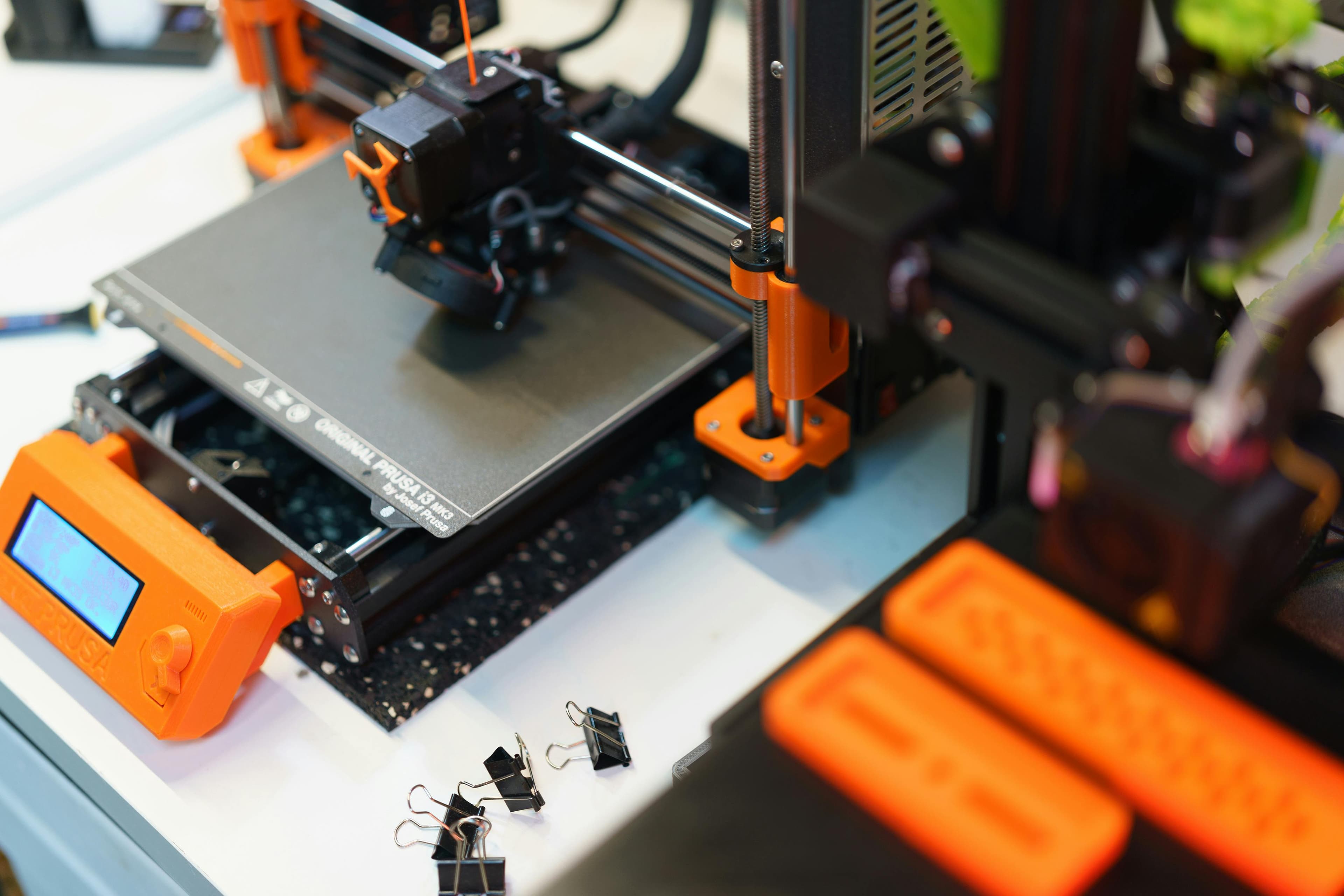
3D-printing has transformed how products are designed, prototyped and manufactured. Instead of machining parts from a solid block, the printer creates them layer by layer directly from a digital model. This approach minimizes waste, speeds up development and makes it possible to manufacture complex shapes that traditional methods simply cannot deliver.
In this guide, you’ll learn how 3D-printing works, what technologies exist, which materials are most common, and where businesses already rely on it for real production.
How 3D-Printing Works
Every 3D-printed object starts with a digital 3D model. Once prepared, the printer slices the model into thin layers and produces them one at a time. These layers fuse together, forming a strong, unified object.
A simplified workflow looks like this:
- Design a 3D model using CAD software or 3D-scanning.
- Prepare the model (slicing, supports, orientation).
- Print the part layer by layer using the chosen technology.
- Post-process the result: cleaning, curing, sanding, painting, or machining.
The biggest strength of 3D-printing lies in its freedom: complex geometries, internal channels and customized shapes are printed as easily as simple blocks.
The Main 3D-Printing Technologies
FDM (Fused Deposition Modeling)
FDM is the most accessible and widely used method. Plastic filament is melted and extruded through a nozzle, forming layers that build up the final object.
Best for:
- Functional prototypes
- End-use parts
- Mechanical components
- Large-format prints
Common materials: PLA, PETG, ABS, ASA, Nylon, Carbon-fiber composites.
SLA (Stereolithography)
SLA printers use a laser or LCD light source to cure liquid resin. The result is extremely high detail and smooth surfaces.
Best for:
- High-precision miniatures
- Jewelry
- Dental models
- Engineering parts requiring tight tolerances
Common materials: Standard resin, engineering resin, flexible resin, high-temp resin.
SLS (Selective Laser Sintering)
SLS uses a laser to fuse nylon powder into solid objects. It requires no support structures, making it ideal for complex parts.
Best for:
- Lightweight functional parts
- Industrial prototypes
- Mechanisms with moving elements
Common materials: Nylon (PA11, PA12), TPU.
Metal 3D-Printing (DMLS, SLM)
Metal printing uses lasers to fuse metal powder into fully dense, production-grade components.
Best for:
- Aerospace
- Automotive
- Medical implants
- Tooling
Materials: Stainless steel, aluminum, titanium, Inconel.
Materials Used in 3D-Printing
Different projects require different mechanical properties. Below is a quick overview of common thermoplastics and their strengths.
| Material | Strengths | Typical Uses |
|---|---|---|
| PLA | Easy to print, stable, affordable | Prototypes, decorative items |
| PETG | Strong, impact-resistant, temperature-stable | Mechanical parts, enclosures |
| ABS/ASA | Durable, heat resistant | Automotive parts, tools |
| Nylon | Tough, flexible, industrial-grade | Gears, hinges, robotic parts |
| TPU | Flexible and rubber-like | Phone cases, seals, wearable parts |
| Resins | Extremely detailed, smooth | Jewelry, miniatures, dental devices |
Choosing the right material determines how the final part performs under load, heat or long-term use.
Advantages of 3D-Printing for Businesses
Rapid Prototyping
3D-printing dramatically speeds up development cycles. Engineers can design, print and test iterations on the same day, drastically reducing time-to-market.
Customization at Scale
Each print can be customized without additional tooling costs. This makes 3D-printing ideal for personalized products or low-volume production.
Complex Geometry Without Extra Cost
Internal channels, organic curves, lattice structures, and overhangs are easy to produce. In many industries, this flexibility gives companies a real competitive advantage.
Low Waste and Efficient Production
Traditional manufacturing cuts material away. 3D-printing uses only what is needed, making it cost-effective and more sustainable.
On-Demand Manufacturing
Businesses can eliminate inventory and produce parts only when needed, reducing storage costs and supply-chain issues.
Real-World Applications
Product Development & Engineering
Teams use 3D-printing to validate design ideas, test ergonomics, create functional prototypes and produce fixtures or tools for the assembly line.
Medical & Dental
Custom implants, orthodontic models, surgical guides and prosthetics benefit from the precision and personalization of additive manufacturing.
Architecture & Construction
Scaled architectural models help clients visualize projects and speed up decision-making.
Automotive & Aerospace
Manufacturers use 3D-printing for weight-optimized parts, custom tooling, aerodynamics testing and even fully functional components.
Hobby, Art & Custom Projects
3D-printing opens opportunities for cosplay, figurines, décor, replacement parts and personalized gifts.
How to Choose the Right 3D-Printing Service
A reliable service should offer:
- Multiple technologies and materials
- Engineering guidance
- Fast turnaround and transparent pricing
- Strong quality control
- Post-processing options
Working with a professional team ensures dimensionally accurate results and materials matched to your project’s requirements.
Key Takeaways
- 3D-printing builds objects layer by layer using digital models.
- It offers unmatched freedom of design and rapid iteration.
- Different technologies suit different needs (FDM, SLA, SLS, metal).
- Material selection determines part strength and use-case suitability.
- Businesses use 3D-printing for prototyping, production and cost savings.
- Professional services deliver higher accuracy, better materials and consistent quality.
FAQ
What is 3D-printing in simple terms?
It’s a manufacturing method that builds objects one layer at a time from a digital file, using materials such as plastic, resin or metal.
How strong are 3D-printed parts?
Modern materials—especially Nylon, PETG, ASA and reinforced composites—can rival injection-molded parts when printed correctly.
How long does a typical print take?
Anywhere from 30 minutes to several days, depending on size, complexity and layer height.
Which 3D-printing technology is best?
There is no universal “best.”
FDM is great for functional parts, SLA for high detail, SLS for industrial strength, and metal printing for high-performance applications.
Is 3D-printing good for production or only prototypes?
Many businesses use 3D-printing for end-use parts, jigs, fixtures, enclosures and low-volume manufacturing.
Can I print large objects?
Yes. Large-format FDM printers can produce oversized prototypes, casings or functional components in a single piece.
Conclusion
3D-printing has become an essential tool for engineers, designers and businesses that value speed, precision and flexibility. Whether you need a prototype, a functional part or a full production batch, professional 3D-printing services deliver efficient and reliable results.
If you have a project in mind, get in touch and we’ll help bring your idea to life.