Large-Format 3D Printing in Estonia
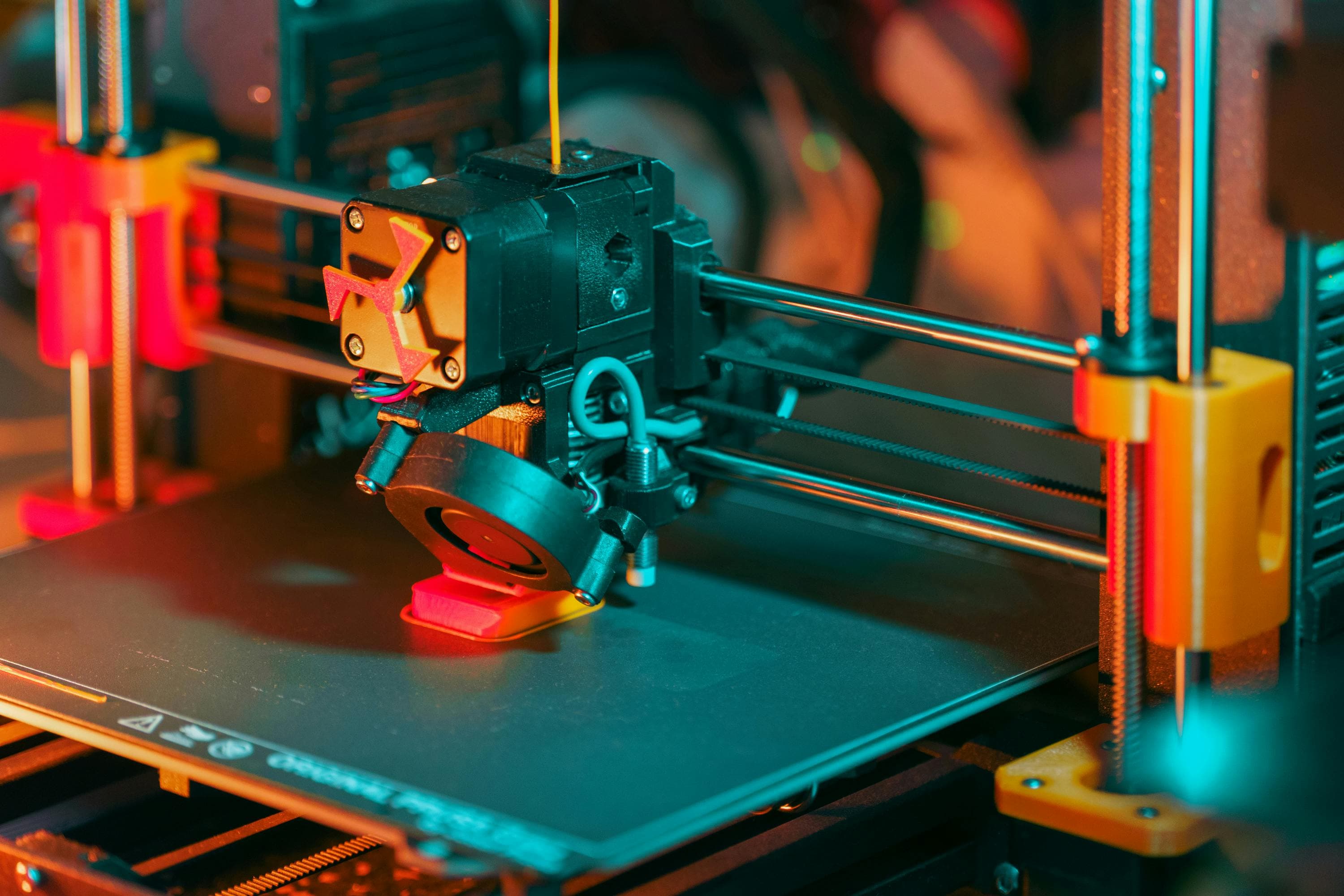
Most consumer printers max out at a 200–300 mm box. If your part is bigger, you're left with two options: split it into sections and glue them together afterwards (visible seams, compromised strength), or order large-format printing. Our large-format printers reach 800 × 800 × 1000 mm — one part, one print, no glue.
This article covers when you need large-format, what it costs, what the limitations are, and how to design for it.
When large-format is the right choice
Three typical situations:
1. The part simply doesn't fit in a smaller box. Large decoration, furniture module, automotive body part, architectural model of a city block.
2. The part must be one piece — for strength or appearance. A structural element where a glue joint would be the weak point. A sculpture where seam lines would be visible and detract from the look.
3. Batches of medium parts. If you order 50 identical medium parts, a large printer prints them in parallel faster than a small printer prints them one at a time.
What we print at large scale
With a single-print maximum of 800 × 800 × 1000 mm, what fits?
- Architectural models — large urban models, full building facades, master plans for client presentations.
- Industrial enclosures — electrical cabinets, weather-resistant outdoor equipment.
- Sculptures and large figures — for exhibitions, mall décor, film and theatre props.
- Automotive — not a whole car, but parts. Body panels, diffusers, spoiler prototypes, interior elements.
- Props and cosplay — large costume components that can't be split without visual compromise.
- Furniture and interior elements — lamps, frames, decorative panels, sculptural furniture pieces.
- Educational models — human anatomy models, fossil replicas for museum exhibits.
Advantages of large-format
No glue seam. The part comes out of the printer whole — no assembly, no alignment, no gluing. Less work, more accurate, better aesthetics.
Full strength. A glue joint is always the weak point. A single-piece print has higher structural strength.
Shorter total time. While one large print takes longer than one small one, assembling multiple small parts requires planning, drying time, and post-processing. Net total is faster with the large print.
Uniform finish. Paint, polish, and surface are identical across the part — glued sections often show differences.
Pricing for large parts
A large print scales with size but also with time:
- Material weight: 500 g (a small enclosure) to 3–5 kg (a meter-tall sculpture).
- Print time: 10–60 hours for simpler work, 80–120 hours for meter-tall complex pieces.
- Material choice: PLA is cheapest, PETG mid-range, carbon variants higher.
Typical price ranges:
- Medium (~300 × 300 × 500 mm) PETG enclosure: €100–250
- Large (~500 × 500 × 700 mm) architectural model in PLA: €250–500
- Meter-tall sculpture in PLA: €400–800
- Large carbon-reinforced engineering enclosure: €400–900
For a precise estimate, use the calculator.
Design recommendations for large parts
Large prints are sensitive to issues that don't show up at small scale. A few important points.
Wall thickness at least 2 mm. Thin walls don't work on a large part — they warp and break during handling. 2–3 mm minimum, internal ribs 4+ mm.
Reinforcement ribs or internal structure. A large hollow volume can warp as it cools. Add internal ribs to hold the form.
Print orientation. Longest dimension vertical = maximum strength in that direction. If the part carries load lengthwise, we print it standing up.
Overhangs. Surfaces beyond 45° require support structures. On a large part, supports add meaningful material cost. Design to minimize overhangs.
Accumulated tolerance. ±0.5 mm is a rounding error on a small part. On a meter-long part, thermal expansion can accumulate to ±2–3 mm. Plan dimensional tolerances accordingly.
When the part doesn't even fit our large printer
If the part is larger than 800 × 800 × 1000 mm, two options:
1. Split and assemble. We split the part logically (furniture base + back support, sculpture head + body), print separately, and join with threaded inserts, glue, or mechanical fasteners. Seams are hidden in finishing.
2. Design simplification. Sometimes the part can be redesigned to be simpler without losing function. We'll discuss this before printing.
Which option makes sense depends on the project. Usually we split into two or three sections, rarely more.
Large print lead time
Smallest "large" part (40 × 40 × 40 cm): 2–4 working days.
Medium (50 × 50 × 70 cm): 4–7 working days.
Maximum (70 × 70 × 100 cm): 7–14 working days.
This already includes queue, print time, cooldown, and finishing. Rush jobs can usually get priority — mention it in the inquiry.
Frequently asked questions
What's the largest single-piece part you've printed?
~100 cm tall sculptures and architectural models. The printer is physically 800 × 800 × 1000 mm; usable build volume is about 780 × 780 × 980 mm after edges.
Is a large print strong?
Yes — stronger than an assembled version. A one-piece print is never weaker than a glued-together part.
Can you install metal inserts in a large part?
Yes. Heat-set threaded inserts (M3, M5, M8) are installed after printing — quick, strong, and serviceable.
Can a large print fail?
A larger part has more risk (delamination, warping, running out of material). We have monitoring and backup systems in place — a main print reaches the customer successfully 95%+ of the time. If something goes wrong early, we restart without an extra fee.
How heavy is a large 3D-printed part?
Depends on material and volume. Hollow shapes under a kilogram, solid constructions up to 5 kg. Shipments under 20 kg are logistically straightforward.
Summary
Large-format 3D printing opens possibilities that smaller printers close off — parts that don't need to be glued together, sculptures in one piece, and industrial enclosures not constrained by consumer printer sizes.
If your project needs a large single-piece part, send us the file and we'll review whether it fits our printer and what would make sense to optimize in the design.
Start a project: contact form or quick estimate via price calculator.