Prototype 3D Printing
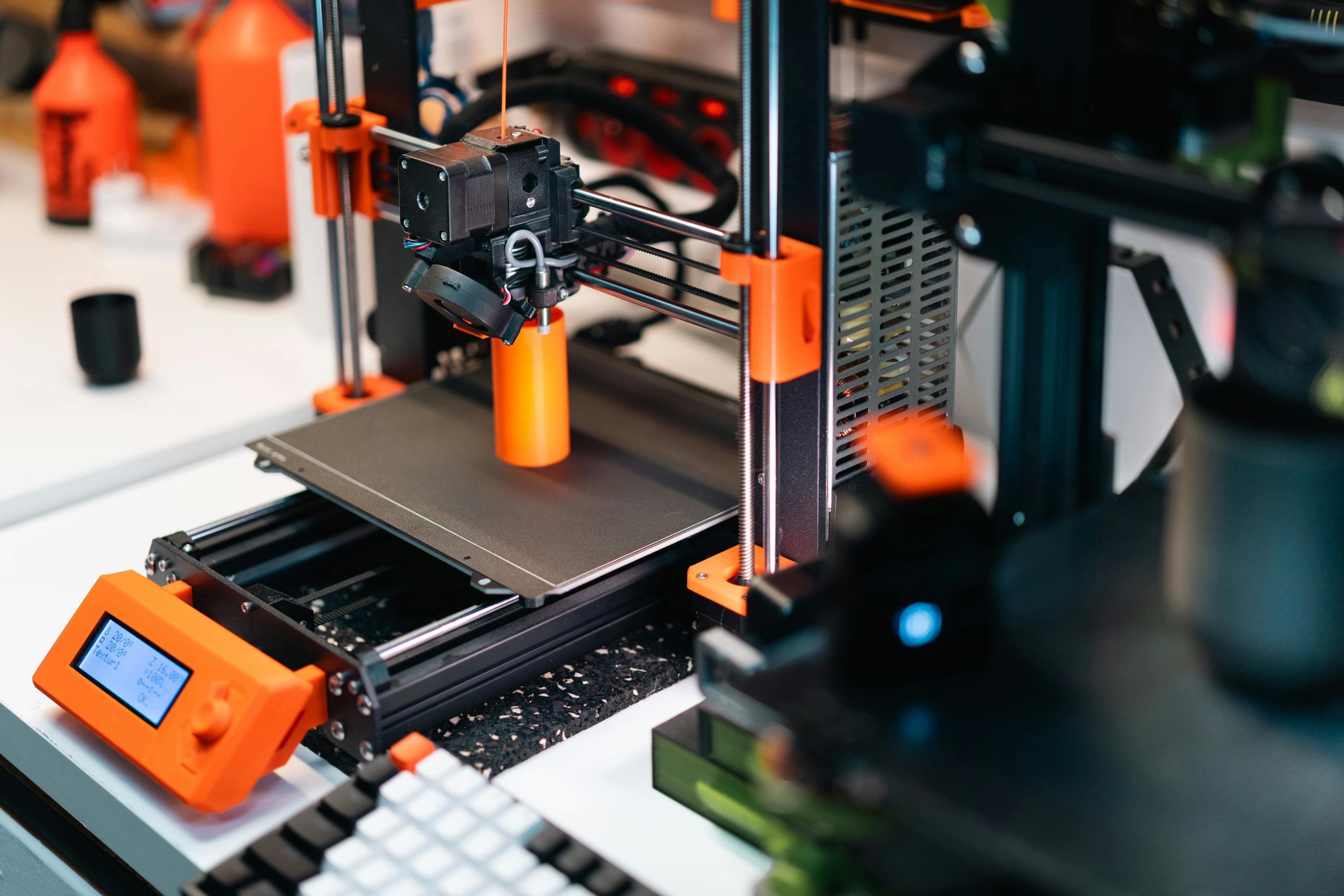
A prototype is the most valuable step in product development. It's the first time your design reaches your hands — and often the last place where you can catch mistakes cheaply. 3D printing is ideal for prototyping because one iteration costs a few tens of euros and takes days, not weeks.
This article explains how companies use 3D printing effectively in product development, what typical lead times and costs look like, and what mistakes newcomers often make.
Why 3D print prototypes
Traditional prototyping — injection mold tools, CNC milling, handcraft — is slow and expensive. One mold can cost thousands of euros and take weeks to produce. If the design doesn't work, you pay again.
3D printing changes that:
- One iteration typically costs €30–200 — depending on material and size.
- Lead time 3–7 working days from first inquiry to part in hand.
- Complex geometry adds no cost — honeycomb structures, internal channels, organic curves print as easily as cubes.
- Design changes are fast — update the file in minutes, next iteration printing the next day.
This turns prototyping into an iterative process where you can test 3–5 variants for the same budget as one injection-molded version.
What a fast prototype cycle looks like
A typical product development cycle with 3D-printed prototypes:
Day 1 — Design. Your engineer or designer creates the CAD model. If you don't have a designer, we can build the model from your drawing or description.
Day 2 — Quote and decision. Send us the file, receive a quote with lead time and material recommendation. Usually same-day response.
Days 3–5 — Printing and finishing. Printing on our large-format printers. Where needed, we add post-processing — sanding, painting, threaded insert installation, assembly of multi-part builds.
Days 5–7 — Testing in your hands. You receive the part and test it. If anything needs adjustment, you let us know.
Days 8–10 — Next iteration. New file, new quote, new print.
Total process: 8–10 days — versus weeks or months in a traditional workflow.
What kinds of prototypes can be 3D printed
Practically any that fit in an 800 × 800 × 1000 mm box. Typical customer needs:
- Product design. A new consumer product where appearance and ergonomics need to be tested.
- Mechanical prototype. A mechanism with moving parts — hinges, sliders, gears.
- Electronics enclosure. Housing for a new device — everything needs to fit, with correct placement for ports, buttons, and displays.
- Mold or casting pattern prototype. Before investing in an expensive metal mold, test with a printed prototype whether the design works.
- Jig or tooling prototype. Production line aids that will eventually be CNC-machined.
- Automotive or equipment part. Replacement for an unknown part or a prototype for an upgrade.
- Medical device model. Not for patient use, but for clinical testing, surgeon preparation, or sales presentations.
Material choice for prototypes
For the first iteration, PLA is almost always the right answer — cheap, fast, sufficiently accurate. Visual review, form and dimension checks, client presentations — PLA supports all of them.
For functional testing (load, heat, real-world use), step up to PETG or PETG Carbon.
For a prototype close to the final product's properties, ABS delivers results near injection-molded parts.
Design recommendations for 3D-printed prototypes
A few simple rules keep costs down and results strong:
Wall thickness at least 1.5 mm. Thinner walls come out brittle and can warp.
Avoid overhangs beyond 45°. Surfaces at steeper overhang angles require support structures, which increase print time and leave marks.
Consider print orientation. Strength is highest along vertical walls, lowest between layers. If the part bears load horizontally, let us know before printing.
Leave at least 0.2 mm clearance between moving parts. The printer isn't nanometer-accurate.
Threads need to be larger than standard — M3 threads don't print well, use M5 or larger, or we'll install metal inserts.
If you're unsure, send the CAD file with a "please review for prototype use" note — we'll check and suggest changes.
Common mistakes and how to avoid them
Mistake 1: Too many iterations at once. Don't order 5 different versions simultaneously. Do the first, test, learn, then order the second.
Mistake 2: Wrong material for first iteration. ABS is stronger, but more expensive and slower. For a "does the form work" first iteration, PLA is enough.
Mistake 3: Overestimating accuracy. FDM printers are accurate to ±0.2–0.5 mm. If you need better — SLA or CNC post-processing.
Mistake 4: Unclear requirements. Before sending an inquiry, decide: what load does the part carry? Where does it run? How hot does it need to handle? Without answers, material recommendation is guesswork.
Mistake 5: Ignoring finishing. Raw 3D prints show layer lines. If presentation matters, plan sanding or painting into the quote from the start.
B2B partnerships and framework agreements
For companies that need prototypes regularly, we offer framework agreements:
- Priority queue placement
- Volume discounts
- Dedicated contact for project inquiries
- NDAs for sensitive designs
If your company plans a regular product development pipeline, write to us mentioning "framework agreement" and we'll agree on terms.
Frequently asked questions
How much does an average prototype cost?
Small part (electronics housing, mechanical piece): €30–80. Medium prototype (consumer product): €80–200. Large or multi-part: €200–500.
Can I provide my own CAD model?
Yes — send us STL, STEP, OBJ, 3MF, or IGES. If you don't have a file, we can build the model from a drawing, photo, sketch, or existing object.
How accurate is a 3D-printed prototype?
FDM tolerance is ±0.2–0.5 mm depending on the part. Sufficient for most prototyping needs. For tighter requirements (±0.05 mm), we'd recommend SLA or CNC post-processing.
Can you help with design improvements?
Yes. We review the file and flag spots where walls are too thin, corners too sharp, or print orientation would give a better result. For simple parts this is typically included in the quote at no extra cost.
What if my prototype doesn't fit?
Iterate. That's normal. Most shipping products go through 3–5 prototype iterations before production. Each iteration is a fresh quote.
Summary
3D printing makes prototyping fast, affordable, and iterative. It's the best product development method when:
- Time matters — days instead of weeks.
- Budget is limited — each iteration costs tens, not thousands, of euros.
- Design must evolve — 3–5 iterations are normal, not a failure.
Start with your prototype: send a file or view the rough estimate in the calculator.